LLMs generate fluent plans for robots but routinely violate the syntactic and semantic
constraints they must satisfy to execute, and existing remedies trade formal guarantees
against plan quality: soft methods (affordance scoring, grounded decoding) give no
guarantee, while symbolic planners (LLM+P) discard the LM's commonsense. We propose
Meta-Ctrl, a constrained-decoding framework that guarantees the encoded constraints
while preserving the base LM's plan quality. Meta-Ctrl introduces meta-tokens—a
compact vocabulary of grounded actions—enforcing syntax at the token level and
semantics (preconditions, goals, ordering) at the action level, an exact factorization that
cuts the memory of constrained decoding from over 107 TB to under 2 GB.
With it, a small open-weight LM becomes competitive where it otherwise sits at the bottom of
the leaderboard: on WAH-NL under the LoTa-Bench protocol it reaches the highest reported
subgoal success rate, exceeding GPT-4's, with strong results across the Embodied Agent
Interface (VirtualHome and BEHAVIOR). We further demonstrate it on a real tabletop robot,
where every generated plan satisfies its preconditions and goals by construction.
Contributions
An exact two-level factorization. Meta-tokens decouple token-level syntax from
action-level semantics, replacing a multiplicative constraint-state space with an additive
one: ~350M DFA states shrink to ~57K, dynamic-programming memory drops from 107 TB to
1.6 GB (~67,000× less), and decoding runs ~1,900× faster.
Guarantees without giving up plan quality. Every output satisfies the encoded
syntactic and semantic constraints by construction—no hallucinated actions, no
precondition or ordering violations—while full-sequence probabilistic lookahead keeps
the base LM's plans fluent and goal-directed.
Small open models pass frontier models. On VirtualHome action sequencing, Llama-3-8B
rises from 21.3 to 88.7 task success rate—above every entry on the Embodied Agent
Interface leaderboard, including Llama-3-70B, GPT-4o, and o1-preview.
Method
Plans must satisfy two kinds of constraints. Enforcing them jointly in a single token-level
automaton blows up to ~350M states; Meta-Ctrl factors the problem across granularities so
each level stays tractable—exactly.
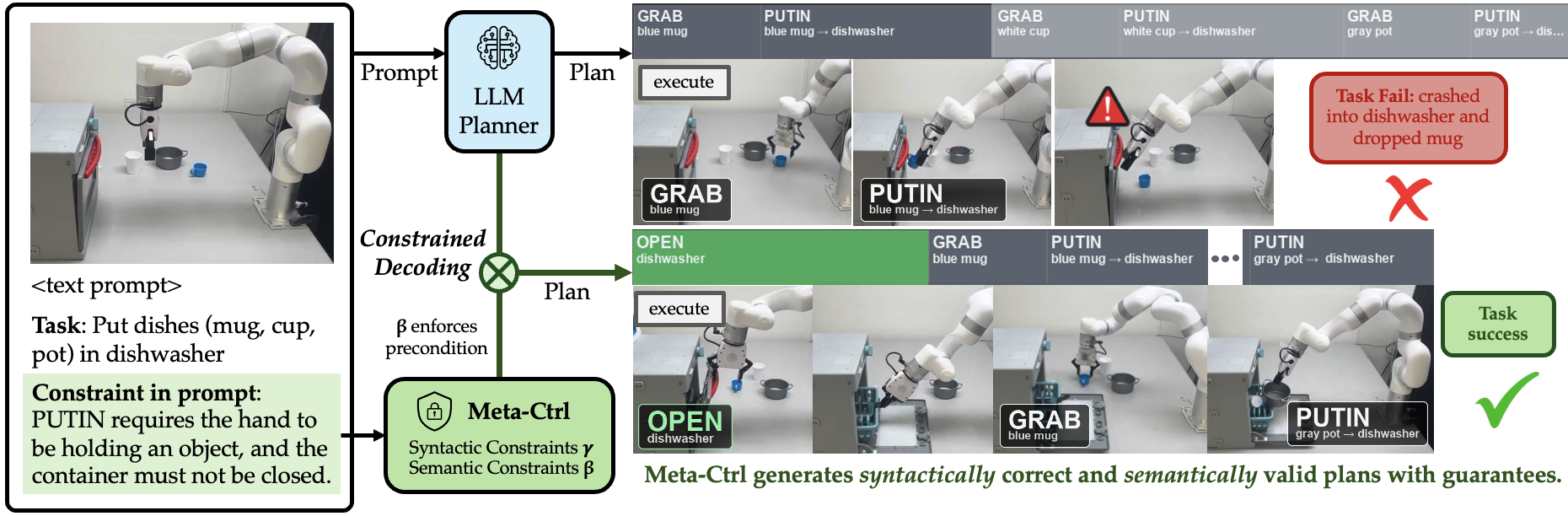
Figure 1: Meta-Ctrl enforces preconditions that the base LM violates.
Task: put dishes in dishwasher; PUTIN requires holding an object
and an open container. The base LM (top) attempts PUTIN while the
dishwasher is closed and the task crashes. Meta-Ctrl (bottom) enforces the action-level
precondition, inserting OPEN(dishwasher), and the task succeeds.
Level 1 — syntactic constraint γ, enforced over tokens.
Valid action names, argument structure and formatting, enforced at the token level with a
DFA. Following Ctrl-G, each token is weighted by a tractable estimate of whether the full
completion can still satisfy γ—keeping the hard guarantee while reasoning about
the whole remaining sequence, not just the next token.
Level 2 — semantic constraint β, enforced over meta-tokens.
Preconditions, goal achievement and ordering over the evolving world state, enforced at the
action level over meta-tokens—a compact alphabet
{ACT, ID0…IDk, EOS} of grounded actions, ~132 symbols
instead of a 128K-token vocabulary.
Table 1: Why two levels — factoring the joint constraint is both cheaper and a better surrogate (median VirtualHome task, hidden size H=128).
Quantity
Monolithic
Two-level (ours)
DFA states
Sγ × Sβ ≈ 350 M
Sγ + Sβ ≈ 57 K
Compute
1,720 T
922 G
DP memory
107 TB
1.6 GB
Surrogate fit (−log p / action)
33.54 (token HMM)
2.01 (action HMM)
~1,900× faster · ~67,000× less memory · ~16.7× better fit.
Formulation
A plan must satisfy a token-level syntactic constraint γ and an action-level semantic
constraint β. Four steps take Meta-Ctrl from probabilistic reweighting to an exact
two-level factorization.
1. Constrained decoding as probabilistic reasoning (Ctrl-G).
$$ p_{\mathrm{LM}}(x_t \mid x_{\lt t}, \alpha)\;\propto\;p_{\mathrm{LM}}(x_t \mid x_{\lt t})\;\cdot\;p_{\mathrm{LM}}(\alpha \mid x_{\le t}) $$
The second factor is the probability that the full sequence will satisfy the
constraint α given the current prefix. It assigns zero mass to tokens with no valid
completion—so satisfaction is guaranteed—and among valid tokens prefers
those leading to fluent, high-probability completions.
2. Tractable lookahead via an HMM and a DFA.
$$ p_{\mathrm{ctrl}}(x_t \mid x_{\lt t}, \alpha)\;\propto\;p_{\mathrm{LM}}(x_t \mid x_{\lt t})\;\cdot\;p_{\mathrm{HMM}}(\alpha \mid x_{\le t}) $$
The exact lookahead is intractable, so α is compiled to a DFA \(\mathcal{D}_\alpha\)
and approximated by a trained HMM. Their product is finite-state, admitting a backward
dynamic program that returns the lookahead for every prefix at cost
\(O(n\cdot|\mathcal{D}|\cdot H^2)\). Composing constraints multiplies DFA sizes
(\(|\mathcal{D}_1|\cdot|\mathcal{D}_2|\))—the bottleneck Meta-Ctrl removes.
3. Two levels via meta-tokens.
$$ x \models \alpha \;\iff\; (x \models \gamma)\;\wedge\;(\tau(x) \models \beta) $$
A parser \(\tau\) maps each syntactically valid token sequence to its sequence of grounded
actions (meta-tokens, e.g. Open(dishwasher));
β is a DFA over meta-tokens tracking preconditions, ordering, and goal
progress. On the γ-valid support, \(\tau\) is a bijection (one canonical tokenization
per action sequence).
4. Exact factorization.
$$ p(\alpha \mid x_{\le t}) = \sum_{a_l} \underbrace{p(a_l \mid x_{\le t})}_{\text{bridging}}\;\cdot\;\underbrace{p(\gamma \mid x_{\le t}, a_l)}_{\text{syntax (tokens)}}\;\cdot\;\underbrace{p_{\mathrm{meta}}(\beta \mid a_{\le l})}_{\text{semantics (actions)}} $$
Bijectivity of \(\tau\) makes the semantics term depend only on the completed-action prefix
\(a_{\le l}\), so syntax (token level) and semantics (action level) decouple exactly,
communicating only through the bridging term \(p(a_l \mid x_{\le t})\). Each level becomes
an independent backward DP—an additive state space instead of a multiplicative
one, the source of the ~1,900× compute and ~67,000× memory savings.
Results
On the Embodied Agent Interface, Meta-Ctrl lifts open-weight LMs to match or exceed
frontier closed models; on WAH-NL it turns an unusable LM into a deployable planner.
Table 2: Embodied Agent Interface — VirtualHome (VH; n=342 AS, 338 SD) and BEHAVIOR (BEH; n=100 AS, 100 SD). Task SR / Execution SR (%). Leaderboard baselines from Li et al.; each base LM is grouped with its full Meta-Ctrl (γ+β) result. Best per column in bold.
Model
Action Sequencing
Subgoal Decomposition
Task SR
Exec SR
Task SR
Exec SR
VH
BEH
VH
BEH
VH
BEH
VH
BEH
Representative baselines
GPT-4o
71.5
47.0
81.3
53.0
87.6
49.0
91.1
55.0
Claude-3.5 Sonnet
76.1
60.0
81.3
69.0
89.1
39.0
92.0
44.0
o1-preview
65.2
81.0
72.5
91.0
89.4
60.0
93.2
62.0
Mistral Large
78.4
33.0
84.6
50.0
84.3
31.0
92.0
38.0
Llama 3 70B Instruct
59.0
34.0
66.6
42.0
78.4
21.0
87.3
30.0
Llama 3 8B Instruct (base)
21.3
10.0
23.6
16.0
48.8
22.0
58.0
29.0
+ Meta-Ctrl (ours)
88.7
34.0
95.7
64.0
88.2
36.0
92.0
53.0
gpt-oss-20B (base)
74.4
40.0
80.3
51.0
72.5
27.0
82.2
36.0
+ Meta-Ctrl (ours)
86.6
40.0
94.1
90.0
82.3
41.0
86.4
66.0
On Llama-3-8B, Meta-Ctrl raises VH Action-Sequencing task SR from 21.3 to
88.7 and Subgoal-Decomposition from 48.8 to 88.2; on gpt-oss-20B
it raises VH AS from 74.4 to 86.6. Both exceed every model on the EAI leaderboard,
including o1-preview, Claude-3.5 Sonnet, and Mistral Large. The lift is smaller on
BEHAVIOR, where prompts encode fewer of the task's preconditions (24% vs 82% on VH),
so less of the constraint can be written into the DFA.
Table 3: Probabilistic lookahead vs. hard masking on Llama 3 8B (Task SR / Exec SR, %). Hard masking applies the syntactic DFA as a local mask each step (standard grammar-constrained decoding); Meta-Ctrl adds HMM backward-DP lookahead. Both enforce the same syntactic guarantee.
Method (Llama 3 8B)
VH AS
VH SD
BEH AS
BEH SD
Hard masking (γ DFA)
1.4 / 97.3
0.0 / 96.0
12.0 / 20.0
19.0 / 31.0
Meta-Ctrl (γ+β, ours)
88.7 / 95.7
88.2 / 92.0
34.0 / 64.0
36.0 / 53.0
Δ Task SR
+87.3
+88.2
+22.0
+17.0
The guarantee is necessary but not sufficient. Hard masking achieves the same syntactic
validity yet collapses task success—greedy decoding steers to the shortest
constraint-satisfying continuation (high Exec, near-zero Task). Full-sequence
probabilistic lookahead recovers task success by +87 to +88 points on VirtualHome.
Table 4: Watch-And-Help (WAH-NL), single-agent, n=100, under the LoTa-Bench protocol. SR: full-task success; SSR: subgoal success; Exec: executable-plan rate. External references use different LMs / executors (ballpark context). Same-LM rows are direct comparisons. †STEP is closed-loop; ours is open-loop.
Method
Base LM
SR
SSR
Exec
External references (different LM / executor)
SayCan
–
0.010
0.021
–
ProgPrompt
–
0.030
0.187
–
LoTa-Bench
GPT-4
–
0.342
–
LoTa-Bench
LLaMA-1 65B
–
0.433
–
STEP†
(larger)
0.400
0.620
–
Same LM (Llama 3.1 8B), same evaluator, n=100
Raw LM (unconstrained)
Llama 3.1 8B
0.000
0.022
0.010
+ syntax (γ)
Llama 3.1 8B
0.000
0.037
0.010
Meta-Ctrl (ours)
Llama 3.1 8B
0.470
0.705
1.000
On the SSR axis comparable across protocols, Meta-Ctrl (0.705) exceeds LoTa-Bench's
strongest reported configuration (LLaMA-1-65B 0.433; GPT-4 0.342) and the closed-loop
STEP baseline (0.620), with every plan executable by construction.
Real-robot deployment
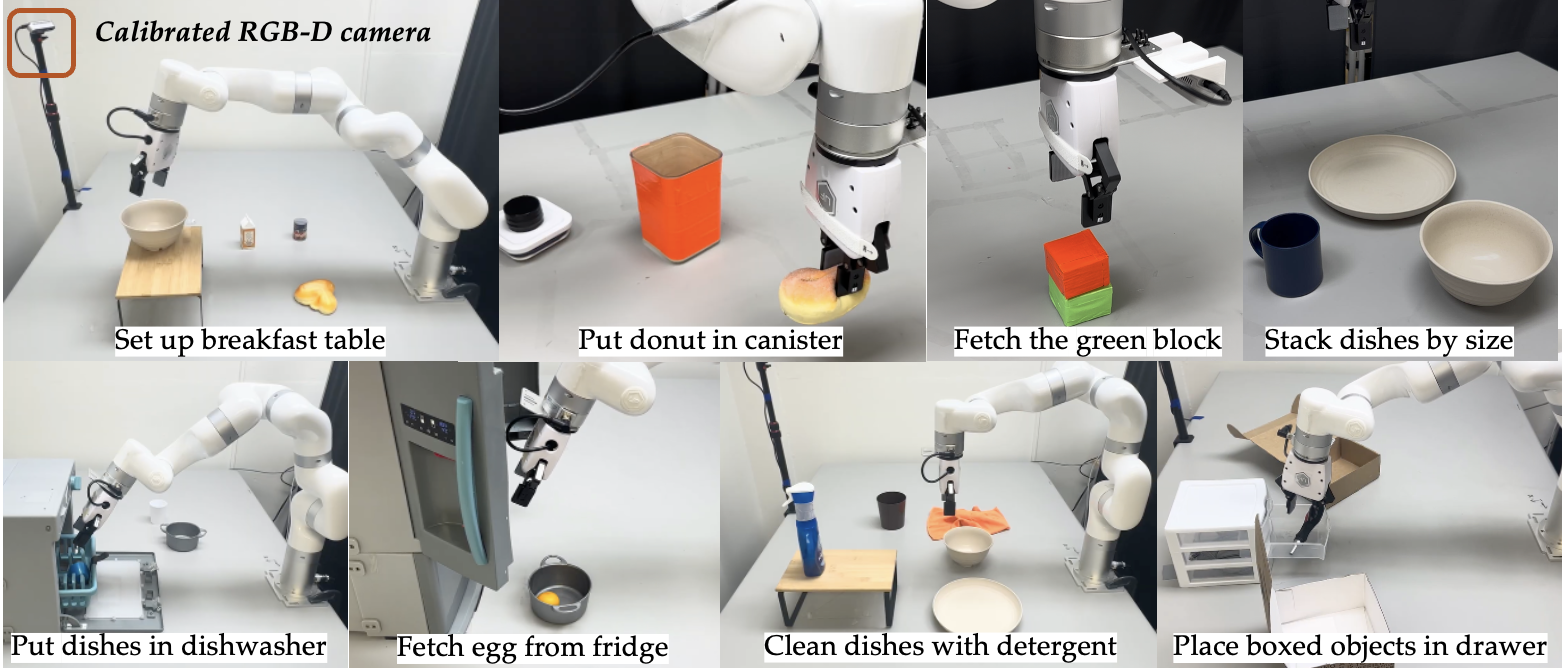
Meta-Ctrl deployed on a physical xArm 7 with a calibrated RealSense RGB-D camera, composing
its plans with a Code-as-Policies executor (Molmo + SAM2 grounding, GraspGen grasps).
Figure 2: Real robot setup with an xArm 7 and deployed tabletop manipulation tasks.
Top-row tasks require only pick-and-place; bottom-row tasks require specialized motion
primitives (e.g. open door). Eight BEHAVIOR-derived long-horizon tasks are
demonstrated; three pick-and-place tasks are evaluated end-to-end over 20 rollouts each.
Meta-Ctrl achieves 100% plan validity by construction on all tasks, including the
multi-step precondition sequences for articulated containers. Its remaining failures occur
downstream of a valid plan (perception or grasp), which isolates cleanly from planning.
Example—put donut into canister: planning 20/20, perception 17/20,
execution 13/17; the unconstrained baseline fails at planning (1/20).
Citation
@inproceedings{yidouweng2026metactrlguaranteedplangeneration,
  title     = {Meta-Ctrl: Guaranteed Plan Generation by Decoupling Syntactic and Semantic Constraints},
  author    = {Gwen Yidou-Weng and Edward Sun and Tianyi Ma and Metin Alp Dogan and Benjie Wang and Allen Peng and Guy Van den Broeck and Yuchen Cui},
  booktitle = {Conference on Robot Learning (CoRL)},
  year      = {2026},
  url       = {https://arxiv.org/abs/2608.22149}
}